

Paragliding Gloves: The Complete Guide to Winter XC Brake Mittens

Cold hands at altitude are more than uncomfortable — they’re dangerous. When your fingers go numb mid-flight, your brake inputs become sluggish, your reaction time drops, and the joy of a long cross-country flight turns into a battle for basic control. Every paraglider pilot who has pushed into autumn and winter flying knows this problem intimately.
The solution isn’t thicker regular gloves. It’s purpose-built paragliding mittens designed around how pilots actually fly. In this guide, we’ll break down everything you need to know about choosing the right winter gloves for paragliding, and why the Paragliding Gloves – Winter XC Brake Mittens from YowFly have earned a 5-star rating from pilots flying everywhere from the Alps to the Indian Himalayas.
Why Regular Gloves Fail Paraglider Pilots
Standard ski gloves and winter gloves are designed for activities where your hands grip poles, handlebars, or steering wheels. Paragliding is different. You need:
- Unrestricted brake travel — your hands must move freely through a full range of motion without the glove bunching or restricting movement
- Tactile feedback — you need to feel the brake pressure and the glider’s response through the toggles
- Easy on/off in flight — you may launch in mild conditions and need to add warmth once you’re climbing into cold air
- Compatibility with brake handles — the glove must work with your brake setup, not fight against it
Regular gloves fail on at least two of these four points. That’s why dedicated paragliding mittens exist.
What Makes a Good Paragliding Winter Glove?
1. Insulation That Doesn’t Bulk Up
The best paragliding gloves use down fill rather than synthetic insulation. Down provides the highest warmth-to-weight ratio, meaning you get serious cold protection without the bulk that kills your brake feel. The YowFly Winter XC Brake Mittens use 60G fill down, which delivers excellent warmth while keeping the total weight to just 160g for the pair.
2. Windproof Outer Shell
At altitude, wind chill is your enemy. Even on a calm day at launch, you can be flying into a 40 km/h headwind at 2,000 meters. A windproof outer shell is non-negotiable. The YowFly mittens feature windproof outers that block the chill while the breathable linings prevent your hands from sweating during active flying.
3. Designed for Brake Handles
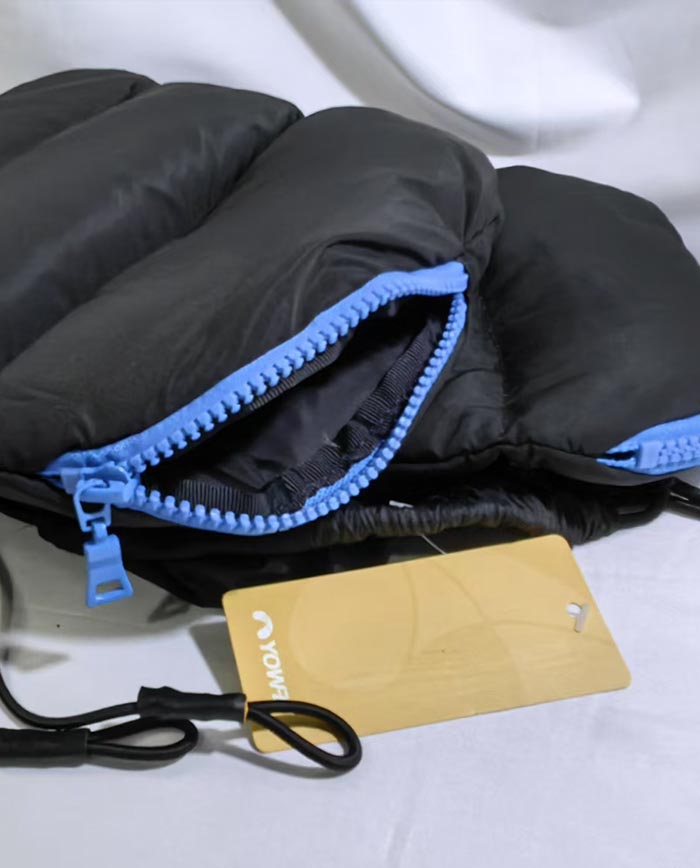
This is the critical differentiator. The YowFly Winter XC Brake Mittens are engineered specifically for paragliding brake handles. The top of the mitten opens with a zip closure, allowing you to slide the mitten over your brake handle once you’re airborne. Two metal rings provide structural support and connect to your brake lines via a karabiner — so the mittens stay attached even if you need to release your hands briefly.
4. Versatile Launch-to-Flight Transition
One of the cleverest features of these mittens is the launch workflow. With the zip open, you wear the mittens as arm sleeves during ground handling and launch — keeping your hands completely free for line checks, risers, and the run. Once you’re airborne and climbing into cold air, you slide the mittens up over your brake handles, zip them closed, clip the karabiner to the brake line, and slide your hands inside. The whole process takes seconds.
YowFly Paragliding Gloves: Full Specifications
| Feature | Detail |
|---|---|
| Type | Brake Mittens / Muffs |
| Insulation | 60G fill down |
| Outer Shell | Windproof |
| Lining | Breathable |
| Weight | 160g (pair) |
| Closure | Zip at top |
| Attachment | 2 metal rings + karabiner clip |
| Supplied | As a pair |
| Rating | 5.0/5.0 (13 verified reviews) |
Real Pilot Reviews
The proof is in the flying. Here’s what verified buyers say:
Karl F. tested these mittens at 5,000 meters in the Indian Himalayas:
“Could not be more happy. Really easy to handle — I always have them in the side pockets of my harness. As soon as it gets cold I take em out, put them on and my hands are getting cosy — without losing the feeling for the glider.”
He also praised YowFly’s customer support after a zipper issue: the company sent a replacement pair within 24 hours, no questions asked.
Kate L. highlighted the professional design:
“I recommend this professional paraglider glove because we need to hold the brakes in our hands, so it needs to be specially made. It’s very warm, professional, and the delivery speed is fast.”
Natalie compared them to regular gloves:
“I have used ordinary gloves before, and the brakes are not easy to handle. This is a professional paraglider glove for use in winter, simple and warm!”
With 100% 5-star reviews across 13 verified purchases, the consensus is clear: these mittens work.
When Should You Use Paragliding Mittens?
Temperature Guidelines
- Below 10°C at altitude: Mittens recommended
- Below 5°C: Mittens essential
- October–November at lower altitudes: You may feel slightly warm — this is normal and expected
- Very cold conditions: Layer a thin pair of liner gloves underneath for extra warmth
The 60G down fill is calibrated for serious cold — pilots report comfort at 5,000m altitude. For mild autumn days, the breathable lining prevents overheating.
Flight Types That Benefit Most
Cross-Country (XC) Flying — Long flights mean extended exposure to cold air at altitude. Mittens are almost mandatory for serious XC pilots flying into autumn and winter.
Hike & Fly — The lightweight 160g design means minimal pack weight. You won’t notice them in your bag until you need them.
Paramotor Flying — The roomy interior accommodates a paramotor throttle, making these mittens compatible with powered paragliding setups.
High-Altitude Flying — As Karl’s Himalayan test proves, these mittens perform at extreme altitude where temperature and wind chill combine to create brutal conditions.
How to Use Your Paragliding Mittens
- Before launch: Open the zip and wear the mittens as arm sleeves. Your hands remain completely free for pre-flight checks, line sorting, and the launch run.
- Once airborne: When you’ve climbed into cold air and want warmth, slide the mittens up over your brake handles.
- Secure them: Close the zip and clip the karabiner to your brake line. This keeps the mittens attached to your brakes even if you release your grip.
- Fly warm: Slide your hands inside and enjoy the warmth. The roomy interior means your brake technique doesn’t change.
- Landing: Unzip and slide the mittens back down your arms before final approach if you prefer bare-hand control for landing.
Paragliding Gloves vs. Ski Gloves: A Direct Comparison
| Feature | Paragliding Mittens | Ski Gloves |
|---|---|---|
| Brake handle compatibility | ✅ Designed for it | ❌ Often restricts movement |
| Brake line attachment | ✅ Metal rings + karabiner | ❌ Not possible |
| Launch flexibility | ✅ Sleeve mode | ❌ Fixed glove shape |
| Weight | ✅ 160g | ❌ Often 300g+ |
| Warmth at altitude | ✅ 60G down, windproof | ⚠️ Variable |
| Price | ✅ Affordable | ⚠️ Often overpriced |
As Karl noted in his review: “Lots of overpriced options for 100+ bugs — and then I stumbled upon those.” The YowFly mittens deliver professional performance at a price that makes sense.
Caring for Your Paragliding Mittens
Down insulation requires a little care to maintain its loft and warmth:
- Storage: Store uncompressed in a dry location. Avoid leaving them stuffed in a tight pocket for extended periods.
- Washing: Hand wash in cool water with a gentle detergent. Tumble dry on low with a couple of tennis balls to restore down loft.
- Drying: Never store damp. Ensure they’re fully dry before packing.
- Zipper: Keep the zip clean and occasionally apply a small amount of zipper lubricant to maintain smooth operation.
The Bottom Line
If you fly in autumn or winter — or if you fly at altitude where temperatures drop regardless of season — dedicated paragliding mittens are one of the most impactful gear upgrades you can make. Cold hands compromise your flying. Warm hands let you focus on the sky.
The Paragliding Gloves – Winter XC Brake Mittens from YowFly tick every box: 60G down insulation, windproof shell, breathable lining, metal ring attachment system, and a clever sleeve-to-mitten launch design that works with your flying rather than against it. At 160g, they weigh almost nothing. At 5.0 stars from 13 verified pilots, they’ve proven themselves in the real world.
Stop fighting cold hands. Fly warm.